
“To lose confidence in one’s body is to lose confidence in oneself.” Simone deBeuavoir
In fifth grade, I thought I was fat. One of my classmates told me I was, so it must be true. Suddenly, my geometric print leggings weren’t just unfashionable, they were now off-limits because my body didn’t deserve them.

― Cheri K. Erdman
To be clear, I wasn’t overweight. The script that girls are sold, though, is that you can never be quite thin enough, no matter how hard you try.
This script starts early.
When I was eleven I ordered a book from the back of Seventeen Magazine, called “The Final Solution”. It was touted as a guaranteed way to shed unwanted pounds. I wasn’t fluent enough in European history at the time to recognize the horror and terrible irony that came along with naming a diet and exercise book aimed at teens after the Nazis plan for systematic genocide.

― Naomi Wolf
That book was my companion well into high school. I would refer to it on occasion, whenever I was feeling particularly motivated to achieve some level of perfection, which I thought would translate to peace. Because God knew my black-only wardrobe and taste for obscure music weren’t doing me any favors in the popularity department. Maybe if I had a tight, toned, my-thighs-don’t-touch-or-jiggle figure I’d get there.
But, despite the messages to the contrary, there is no peace in the struggle for ‘perfection’.
In elementary school, I wore basically whatever I wanted. In middle school, I’d transitioned to baggy skater clothes, the better to hide my weird body with. By high school, I’d found some kind of middle ground: I could wear tighter shirts, if my pants were super baggy. I could get away with the occasional pair of belled leggings, if my shirt was three times too big for me. Because as much attention as I called to myself by wearing vinyl and spiked collars and anti-swastika patches, I still didn’t want anyone to see the way I was shaped.

Through these years I would try on different diets, often following in my parent’s hopeful steps. The Atkins diet was particularly memorable. I would eat hot dogs without the buns, dipped in mustard. Slices of packaged cheese. Artificially sweetened anything. Then, I would pee on a little strip of paper and hope hope hope that it turned a dark shade of red, indicating that my young and developing body had reached a state of ketosis.
Exercise came into my life only sporadically. My dad liked TV, my mother liked books, so even though we lived at the foot of the Pikes Peak, we weren’t an outdoorsy bunch. When I did get active, it would be alone, in my room, usually with a slender volume I pilfered from my mom’s bookshelf: Callanetics. The cover featured the middle portion of a slender woman in a leotard, with the title resting in her curves. The exercises themselves have merit; my approach to them, however, was rooted in low self-esteem and the search for a magic body bullet.
Aside from that, I didn’t play sports or go on hikes or really do much at all beyond reading and writing and (failing at) ‘rithmetic.

― Naomi Wolf
These were the same years that I learned to use my body as a commodity. Any contributions my personality could bring to a relationship paled when compared to the contribution this body could offer. Consequently, if I wasn’t hooking up with at least one guy, I didn’t consider myself worth much at all.
This method of trade immediately broke down when applied to my friendships and my intimate relationships with women. By and large, I wasn’t sleeping with the people in my friend group. And when it came to having a girlfriend, well, I was just so damn confused by the whole thing that I had no idea what to do.
Because this idea of sex as my primary value was so strong in my mind, it became incredibly difficult to navigate any relationship that wasn’t between me and a guy who wanted to sleep with me. I would occasionally have a kind of close female friend, but not often, and not for long. I would try to seduce most of my male friends from time to time. It took more than a decade after I got out of high school before I learned how to really have a friendship, no sexy strings attached. To this day, maintaining those friendships is a challenge. I still wonder what I could possibly have to offer.
 My story is not unique. It is, in fact, distressingly common. Girls who wreak havoc on their hormones by going on unnecessary diets. Women who wonder what they’re bringing to the table, if they’re not opening their legs. Lives defined by the vehicle we were granted for this incarnation, rather than the soul it carries around. Bullying and advertisements, parents and peers and presidents, all telling us that we are only as good as our stomach is flat. Even that isn’t a winning score, though, because you’re still just a body. An object that belongs to someone else. Someone who knows what you need.
Here’s the thing: I’m a human being. All those people trying to tell me what I need? They’re human beings, too. And there is no way in hell they could be more knowledgeable about my mind, my body, and my needs than me.
So, hands off. This belly, these breasts, this smile and this heart are for me.
If I like you, a lot, maybe I’ll share.

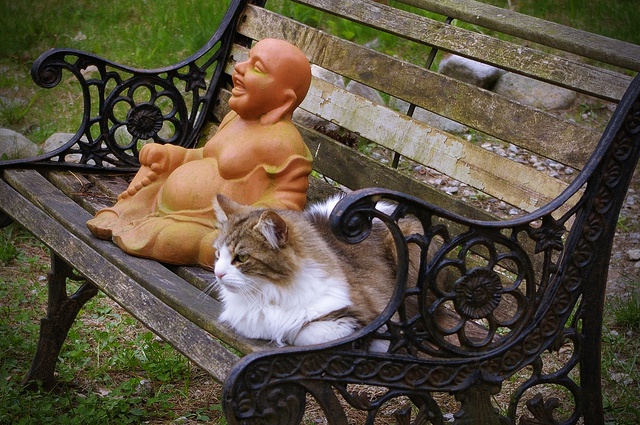

 It took another couple years before I started getting into the woo. You know what I mean. Crystals. Shamans. Sage bundles and deities and chanting.
 I’m not saying to attack for the sake of attacking. Rather, examine, in search for deeper answers, for more integrity, more beauty. When we stop looking, we start solidifying. Growing rigid. Moving out of the flow of the Universe.


 Problem is, it doesn’t know how to tell the difference between life-threatening, and literally everything else. Elizabeth Gilbert describes this voice’s refrain as a monotonous, unending no. That’s the answer to every possibility: no. Am I doing enough? Am I worthy? Am I okay? No, no, no. Can I succeed? Do people love me? Will this work? No, no, no.
 And this is the same message I get from many self-help books, articles on self-care, and discussions with well meaning people. It’s just a matter of taking control. Making those choices.


 A Sacred Fire burned throughout the festival, attracting Water Protectors from Standing Rock, Storytellers weaving joy out of words, elders leading ceremony, and, of course, people eager to get warm after chilly Colorado storms. This space made the festival for me. The music was great, the workshops and yoga classes I attended were lovely, but the Fire and the environment it created were what took me from hopelessness to having more ideas than I knew what to do with.

 In time, though, I would realize that the payment for security is, too often, freedom. That being held can feel like being trapped. That what once felt perfect and complete can dissolve, like metal exposed to the sea air, rusting away until collapse is inevitable. None of which invalidates what was. I’ve come to understand that the success of a relationship can’t be judged by the length of the relationship, but by the health of it. Had neither of us uttered those four words-like-coffin-nails, and we somehow continued down the road we’d been going, there would have been precious little happiness. What’s the point of celebrating twenty years together if both parties are unfulfilled?

 Untangling this mess requires going way back, and honestly, I’m not sure where to start. With my father, probably, because it always starts there. The first relationship where I felt like I’d been given up on. Without his influence on my life, without that through-line of feeling like I was broken and awful and defective running through most of my childhood, I probably wouldn’t have cheated on Every. Single. Person. I dated. I probably wouldn’t have slipped down the hole of drugs. I probably wouldn’t have felt the need to become the smallest, spikiest ball of anger I possibly could. (I’m not blaming him. He did the best he could with what he had. We all do. That doesn’t change the scars that I have to carry.)
 I have to move forward with what I have. I have to find a way to move forward that doesn’t just translate to running away. Because that would be easy, to sprint as fast as possible in the opposite direction whenever I find myself in a situation that pushes on these points. I’ve done it before. More often, I get a running start, then chuck a grenade behind me to make sure I can’t go back.


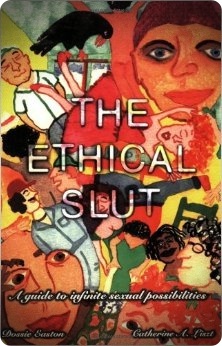 When I was sixteen, I was given a book called The Ethical Slut. Many of you have probably heard of it, or read it. For those who haven’t, it’s an inspiring nonfiction work on the practice of ethical polyamory. I ate it up. I identified with the author’s views on love, and sex. This idea that we should be able to love freely and let relationships grow organically appealed to me immensely. That we shouldn’t be ‘tied down’ to one, monogamous relationship. That ‘sex is nice, and pleasure is good for you’. The information in that book took root, and from that point on I identified as polyamorous.
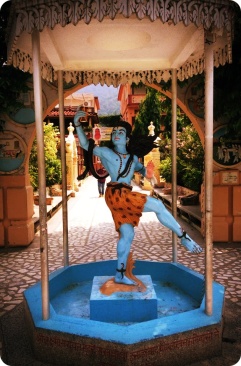 As I’ve grown stronger in my relationship with God, and as I’ve found a more personal relationship with Shiva in particular, this need I’ve felt to embrace polyamory has evaporated. It’s a strange feeling, but, like I said, there is a spaciousness left in its place.
